Taming the Bull: What 1.5 Billion Games Reveal About Chess's Newest Named Opening
What happens if you ignore your opponent's opening and simply push the h-pawn twice? I searched 1.5 billion Lichess games to find out.
July 22, 2026 update: After publishing this article, several readers pointed me toward earlier references to a flank-attacking system called the Beaver Claw, associated with FM Maxim Omariev. Interestingly, Omariev even employed 1...h5 followed by 2...h4 against Anna Cramling in a 2023 game. I'm currently investigating whether Beaver Claw specifically referred to the same two-move pattern studied here (1.h4 followed by 2.h5 as White, or 1...h5 followed by 2...h4 as Black), or whether it describes a broader family of rook-pawn flank attacks. Once I've verified the historical sources, I'll update this article accordingly.
The statistical analysis presented in this article is unaffected by the historical naming question. The study measures how often the move sequence appears and how it performs across 1.5 billion Lichess games, regardless of what players chose to call it.
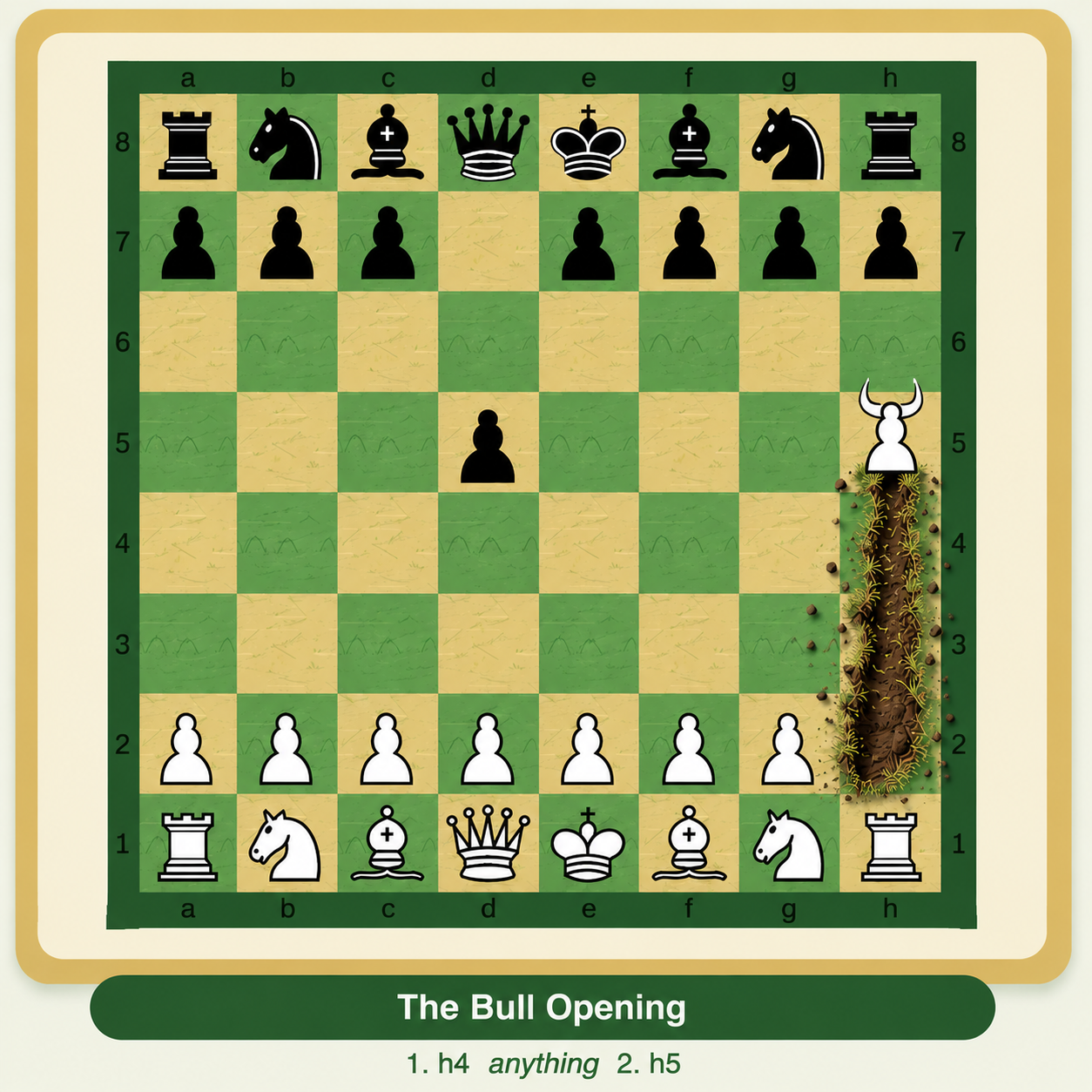
Anna Cramling recently introduced a simple opening idea she calls the Bull: push the h-pawn twice, regardless of what the opponent does.
That raised two natural questions.
Had players already been doing this?
And does it actually work?
To find out, I scanned more than 1.5 billion rated standard Lichess games from January 2025 through May 2026.
The answer to the first question was immediate: the archive contained 1,389,278 Bull attempts.
One player alone played the Bull more than 20,000 times during the study period.
The answer to the second was more nuanced than I expected. Among stronger players in fast time controls, the Bull performs surprisingly well. Among lower-rated players, especially in slower games, it performs noticeably worse.
That is broadly consistent with Anna Cramling's practical framing of the Bull in her YouTube video: an unusual weapon for faster games against stronger opposition.
What the data says
- 1,389,278 Bull attempts were found.
- More than 90% occurred in Bullet or Blitz.
- At 1600+, the Bull beats matched benchmarks in fast games.
- Below 1600, it generally underperforms, especially as games become slower.
What Counts as the Bull?
The detector is intentionally simple.
| Side | Exact detector |
|---|---|
| White Bull | White's first two moves are h4 and h5. |
| Black Bull | Black's first two moves are ...h5 and ...h4. |
The opponent's replies do not matter.
A Bull attempt is counted from the player-side perspective. Each game gives White and Black one opportunity to attempt the Bull, so 1.548 billion games correspond to 3.096 billion player-sides.
That distinction matters for frequency: the Bull appeared in 0.0449% of player-sides, or 4.49 attempts per 10,000 player-side opportunities. Since each game has two player-sides, that is about 8.97 Bull attempts per 10,000 games when both colors' opportunities are counted, or roughly once every 1,114 games on average.
The Headline Numbers
| Metric | Result |
|---|---|
| Rated standard games scanned | 1,548,076,590 |
| Player-sides scanned | 3,096,153,180 |
| Bull attempts | 1,389,278 |
| Attempt rate per player-side | 0.0449% |
| Attempts per 10,000 player-sides | 4.49 |
| Attempts per 10,000 games, both colors counted | 8.97 |
| Approximate game frequency | 1 per 1,114 games |
| Bull win rate | 48.55% |
| Bull score rate | 50.31% |
On the surface, the Bull looks close to neutral. The full-sample score rate is 50.31%, barely above an even score.
But that average hides the real story: time control, rating, color, and player selection all matter.
The Bull Had Already Been Roaming Lichess
The archive establishes that the exact move pattern predates the video at meaningful scale. It cannot establish who first conceived, independently discovered, taught, or named it.
In January 2025 alone, the scan found 95,590 Bull attempts.
When Anna Cramling introduced the Bull on YouTube, she presented it as something that is effective in fast-format games at relatively high Elo levels. In other words, a practical fast-game weapon against strong players, and that is exactly where the data is most supportive: in the 1600+ sample, the Bull scores +3.78 percentage points (pp) versus its matched benchmark in Bullet and +1.05 pp in Blitz.
Anna is also strongly associated with the Cow Opening, another memorable animal-named system she introduced to a wide chess audience. The Bull is a natural follow-up: a simple, recognizable idea packaged under a name players can remember immediately.
Whatever its earlier history, Anna deserves credit for recognizing the pattern's practical identity, highlighting the conditions where it appears to work best, giving it a memorable name, and bringing it to a much larger audience.
The data also shows that the pattern was not driven by one account.
| User concentration | Share of all Bull attempts |
|---|---|
| Top 1 user | 1.50% |
| Top 5 users | 4.13% |
| Top 10 users | 6.49% |
| Top 25 users | 11.71% |
| Top 100 users | 24.02% |
| Top 1,000 users | 47.51% |
The top user accounts for a large personal sample, but not enough to explain the aggregate result. The Bull pattern is distributed across a long tail of players, with a smaller group of high-volume specialists.
The Bull Is Mostly Speed Chess
To understand where the Bull succeeds, it helps to start with where people actually play it.
| Game type | Bull attempts | Share of attempts |
|---|---|---|
| Bullet | 815,325 | 58.69% |
| Blitz | 447,635 | 32.22% |
| 10+0 rapid | 93,309 | 6.72% |
| >10 min rapid | 28,467 | 2.05% |
| Classical | 4,166 | 0.30% |
| Correspondence | 376 | 0.03% |
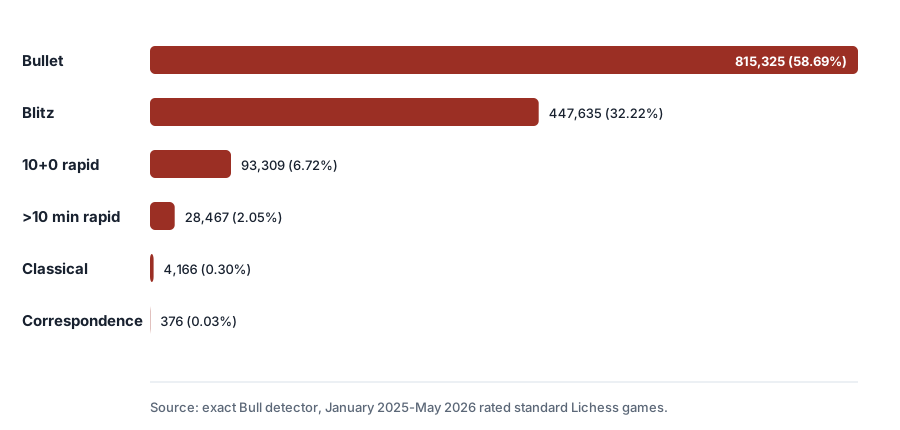
The Bull is first and foremost a speed-chess opening. More than 90% of all attempts occur in Bullet or Blitz, and its results change sharply as the clock gets slower.
Does It Actually Work?
A raw comparison against all non-Bull games is not good enough, because Bull attempts are not evenly distributed by rating, time control, color, or castling profile. The fairer comparison is to match by 200-point Elo bucket, color, castling profile, and game type, then compare Bull results to non-Bull results in the same cell.
Here is the matched game-type table:
| Game type | Bull games | Bull score % | Matched benchmark | Score gap |
|---|---|---|---|---|
| Bullet | 815,325 | 52.37% | 49.50% | +2.87 pp |
| Blitz | 447,635 | 48.14% | 48.45% | -0.32 pp |
| 10+0 rapid | 93,309 | 46.23% | 47.89% | -1.66 pp |
| >10 min rapid | 28,467 | 40.82% | 47.70% | -6.88 pp |
| Classical | 4,166 | 37.95% | 47.06% | -9.11 pp |
| Correspondence | 376 | 35.90% | 47.91% | -12.00 pp |
The cleanest summary is:
The Bull looks good in Bullet, roughly neutral in Blitz, and bad in slower games.
In a fast game, the Bull creates an unusual position immediately. In a slow game, the opponent has more time to decide how seriously they need to respond to the setup.
That overall picture hides the article's most surprising finding. Once the results are split by player rating, the Bull behaves almost like two different openings.
Table 2. Matched Bull performance by rating group and time control.
Performance by Rating and Time Control
| Rating group | Game type | Bull games | Bull score % | Benchmark | Gap |
|---|---|---|---|---|---|
| Below 1600 | Bullet | 158,933 | 46.81% | 47.70% | -0.89 pp |
| Below 1600 | Blitz | 230,564 | 46.05% | 47.65% | -1.60 pp |
| Below 1600 | 10+0 rapid | 66,366 | 44.93% | 47.46% | -2.52 pp |
| Below 1600 | >10 min rapid | 22,519 | 38.68% | 47.14% | -8.46 pp |
| 1600+ | Bullet | 656,392 | 53.71% | 49.94% | +3.78 pp |
| 1600+ | Blitz | 217,071 | 50.35% | 49.31% | +1.05 pp |
| 1600+ | 10+0 rapid | 26,943 | 49.43% | 48.97% | +0.47 pp |
| 1600+ | >10 min rapid | 5,948 | 48.93% | 49.83% | -0.90 pp |
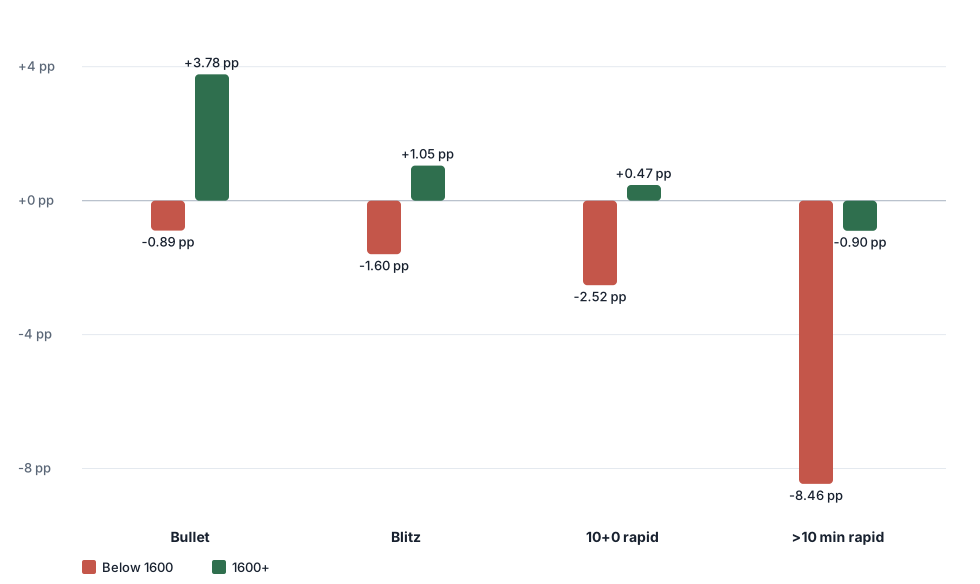
The Bull is almost two different openings.
Below 1600, it generally underperforms.
At 1600+, it becomes a surprisingly credible practical weapon in fast chess.
For lower-rated players, the early h-pawn rush often appears to create weaknesses without enough compensation. Stronger players seem better able to turn the unusual position into a practical weapon, particularly when the clock is short.
That is why the result is more supportive of Anna's practical framing than the overall average first suggests. The data does not say "play it everywhere." It says the Bull is most credible as a fast-game surprise weapon in stronger-player pools.
That is an observational interpretation, not a causal claim. The players who choose the Bull are not a random sample.
Who Chooses the Bull?
The Bull attempt rate initially falls as ratings rise through the beginner range, reaching its lowest point around 1200-1599. It then reverses direction sharply. From 1600 upward, stronger players choose the Bull increasingly often.
This U-shaped pattern resembles something I have repeatedly seen while building the Elo+Chess benchmarking engine: questionable opening habits tend to decline through the beginner and intermediate ranges, but stronger players sometimes reintroduce rule-breaking moves deliberately. The broader Elo+Chess benchmarking methodology is available here: methodology PDF.
The Bull may therefore represent two different behaviors under the same move sequence: an undisciplined early pawn rush at lower ratings and a deliberate surprise weapon among stronger speed-chess players.
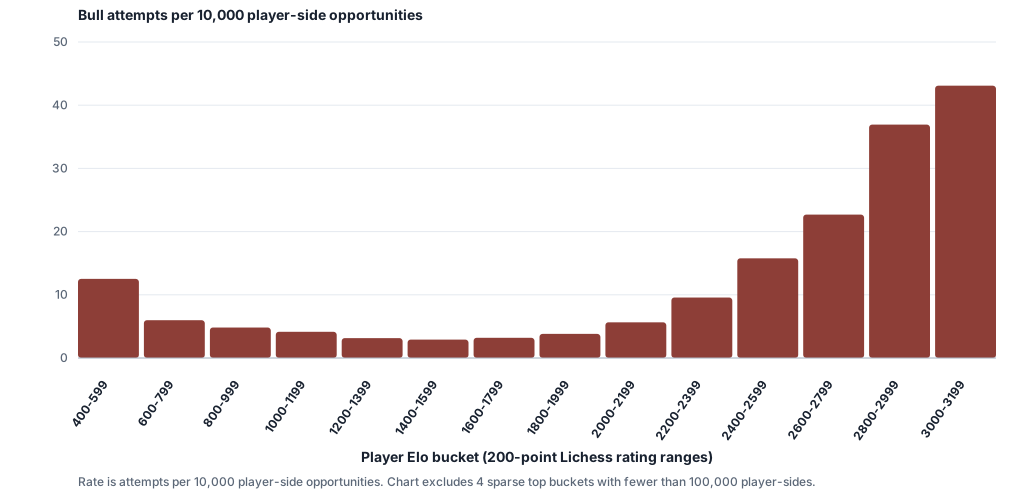
The Bull is not secretly a universal opening system. It is a surprisingly credible speed-chess weapon in the hands of stronger players.
The Specialist Effect
There is a clear player-selection issue. Bull attempts skew stronger than the overall population.
| Elo pattern | Result |
|---|---|
| Average Bull-attempt Elo | 1,792 |
| Median Bull-attempt Elo | 1,824 |
| Bull attempts from 1600+ players | 65.31% |
| Total population sides from 1600+ players | 55.95% |
The specialist comparison makes the issue even clearer.
| Group | Games | Score % | Matched benchmark | Gap |
|---|---|---|---|---|
| 100+ Bull players, Bull games | 727,355 | 52.57% | 50.35% | +2.22 pp |
| 100+ Bull players, non-Bull games | 10,864,762 | 52.26% | 50.98% | +1.27 pp |
Frequent Bull players already outperform comparable players when they do not play the Bull. That means part of the specialist edge likely reflects who chooses the opening rather than the opening alone.
The comparison does not provide a clean causal estimate of how much credit belongs to the opening.
One public Lichess username illustrates how specialized some repertoires are. Henry1787 played the Bull 20,861 times in 21,508 eligible games during the sample period, about 97% of their eligible games. That is remarkable evidence of an extreme specialist repertoire.
But Henry1787 still accounts for only 1.50% of all Bull attempts. No single player explains the aggregate result.
Personal Bull-versus-non-Bull comparisons are also hard to interpret because high-volume specialists often have very small non-Bull samples, and those games may differ by time period, time control, rating, opposition, or playing style.
| Public Lichess user | Bull games | Bull score % | Non-Bull games | Non-Bull score % |
|---|---|---|---|---|
| Henry1787 | 20,861 | 49.03% | 647 | 37.48% |
| srhn1981 | 10,059 | 51.05% | 1,224 | 41.63% |
| mahmoodebadi1986 | 9,810 | 49.47% | 823 | 41.98% |
| zugzwang911* | 8,395 | 67.96% | 11,473 | 66.89% |
| ildar-80 | 8,226 | 51.99% | 438 | 47.49% |
| iSUpobedu | 7,538 | 55.65% | 1,442 | 51.91% |
| MiltonOliver | 7,165 | 55.70% | 1,649 | 40.90% |
| HugoStyglits | 6,489 | 51.79% | 5,095 | 49.47% |
Note on zugzwang911: This account's raw score is unusually high, but the opponent pool was also unusual. Across all eligible games in the sample, zugzwang911 averaged about 2,199 Elo while opponents averaged about 2,005 Elo, an average rating edge of roughly 195 points. A score near 67% is therefore close to Elo expectation rather than evidence of a rating surge by itself.
These are public Lichess usernames from public game records. The table is about aggregate game behavior, not personal identity.
White, Black, and Castling
The Bull is not symmetric by color.
| Color | Bull games | Bull score % | Matched benchmark | Gap |
|---|---|---|---|---|
| White | 566,683 | 50.25% | 51.10% | -0.85 pp |
| Black | 822,595 | 50.35% | 47.57% | +2.78 pp |
White Bull games without castling perform poorly, especially at lower ratings, while Black's relative advantage is concentrated partly in messy, uncastled games.
This is descriptive, not causal. "Did not castle" often means the game ended before castling became possible.
Detailed castling table:
| Color and eventual castling | Bull games | Bull score % | Matched benchmark | Gap |
|---|---|---|---|---|
| White kingside | 66,017 | 53.59% | 52.65% | +0.94 pp |
| White queenside | 144,045 | 54.87% | 53.20% | +1.66 pp |
| White none | 356,621 | 47.77% | 49.96% | -2.19 pp |
| Black kingside | 97,454 | 52.57% | 50.07% | +2.50 pp |
| Black queenside | 238,017 | 53.52% | 51.35% | +2.17 pp |
| Black none | 487,124 | 48.36% | 45.23% | +3.13 pp |
Does It Make Opponents Think?
If the Bull is a practical speed-chess weapon, maybe the point is not objective soundness. Maybe the point is that the opponent spends time deciding what kind of position they are looking at.
The full-sample timing result did not support a simple slowdown story, because the full average is dominated by time-control mix. The cleaner check is 1600+ Bullet and Blitz.
| Format | Games | Facing Bull | Comparison | Difference |
|---|---|---|---|---|
| Bullet | 656,392 | 0.883 sec/move | 0.920 sec/move | -0.037 sec/move |
| Blitz | 217,071 | 2.920 sec/move | 2.592 sec/move | +0.328 sec/move |
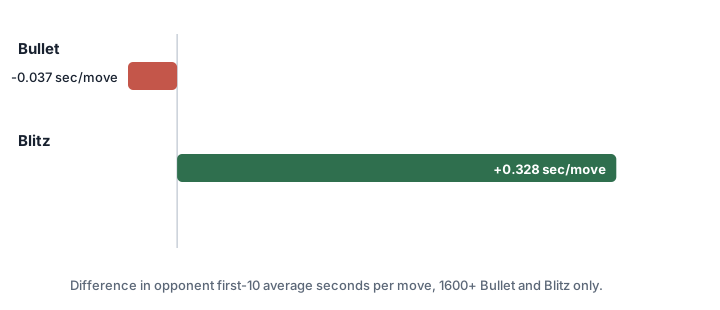
In Bullet, there is no evidence that the Bull makes opponents hesitate. In Blitz, opponents facing the Bull spend about 0.33 extra seconds per move during their first ten moves, roughly 3.3 seconds total.
That timing gap is associated with the Bull in this dataset. It should not be read as proof that the opening caused every extra second.
What the Data Does and Does Not Show
This is observational data. It does not prove that the Bull causes a player to perform better or worse.
The biggest practical confounder is player selection: Bull players, especially frequent Bull specialists, are stronger than the general population and perform above matched benchmarks even in non-Bull games.
The second confounder is time control. A result that is true in Bullet may be false in Blitz or rapid.
The third caveat is downstream game state. Castling profile is descriptive because castling happens after the opening choice.
Conclusion
The Bull is neither a brand-new move sequence nor a secret universal opening system. The exact pattern had already appeared more than a million times in the Lichess archive.
Its practical value depends heavily on who is playing and how much time is on the clock. Below 1600, particularly in slower games, the Bull generally underperforms. Among stronger players in Bullet, it becomes a much more credible surprise weapon, although some of that edge belongs to the specialists who choose it.
The best interpretation is not "play the Bull because the win rate is high." It is that online speed chess rewards familiarity, surprise, and comfort in positions the opponent does not see every day.
In online chess, annoyance is a real strategic category.
Whether or not Anna Cramling was the first person to play the pattern, she may become the person who gave millions of players a memorable way to think about it. The Bull had already been roaming wild across online chess for quite some time. Now it has a name.
Methodology
I scanned rated standard Lichess PGNs from January 2025 through May 2026.
The detector was exact:
- White Bull: White's first two own SAN moves are
h4andh5. - Black Bull: Black's first two own SAN moves are
h5andh4. - Opponent moves are ignored.
- Results are counted from the Bull player's perspective.
Games involving bots, unrated games, variants, and games without both ratings were excluded.
The main buckets are 200-point player Elo buckets. Game types are derived from Lichess event/time-control metadata and grouped as Bullet, Blitz, 10+0 rapid, >10 min rapid, Classical, and Correspondence.
For timing, Bull games were parsed exhaustively from Lichess clock comments. Non-Bull timing used a deterministic 1-in-1000 population sample of eligible games where neither side played the Bull. Timing averages are recomputed from raw summed seconds and move counts.
The main performance comparisons use matched non-Bull baselines by rating bucket, color, castling profile, and game type where noted. Castling-side tables are descriptive because castling is a downstream event, not a pre-opening condition.